
A look back at “Conceptual Blending Across Cultures, Texts, and Traditions”
At the heart of the two-day event was the question of how Conceptual Blending Theory can contribute to the comparative study of metaphor, religion, and meaning-making across cultural, linguistic, and textual boundaries.
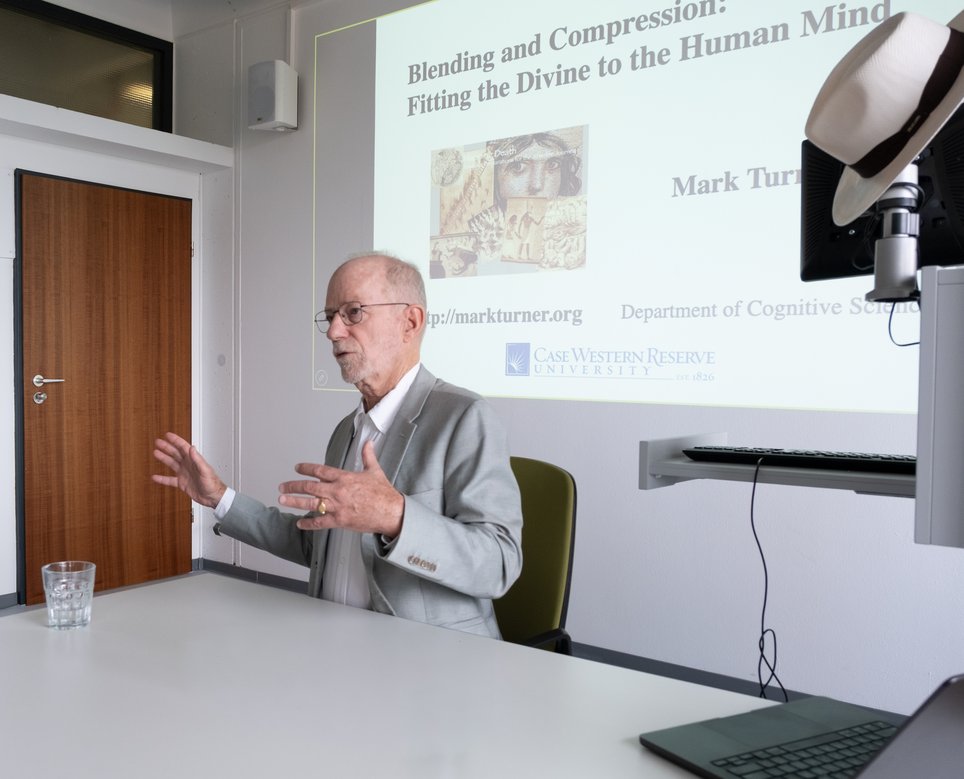
A particular highlight was the keynote lecture “Blending and Compression: Fitting the Divine to the Human Mind” by Mark Turner, Professor of Cognitive Science at Case Western Reserve University in Cleveland, Ohio (USA). Turner is one of the leading scholars in the development of Conceptual Blending Theory. Together with cognitive scientist Gilles Fauconnier, he developed the theoretical model that describes how people combine elements from different mental spaces to generate new conceptual structures and meanings. The approach gained particular influence through their co-authored book The Way We Think: Conceptual Blending and the Mind’s Hidden Complexities (2002).
Turner’s research extends far beyond language in the narrow sense. He studies fundamental cognitive operations underlying human creativity, invention, reasoning, imagination, and meaning-making. He has applied his work on Conceptual Blending to fields including literature, art, science, mathematics, politics, social cognition, and religion. At the heart of his research is the question of how people combine ideas from different domains—for example, experiences from the everyday world with ideas of the divine—and thereby create new meanings and ways of understanding.
This perspective is particularly relevant to the study of religious metaphors. Religious concepts often bring together domains that may initially seem far removed from one another—for example, the human and the divine, the material and the transcendent, or everyday experience and abstract theological concepts. Turner’s work on Conceptual Blending provides a framework for examining how such connections are established cognitively and how new structures of meaning emerge from the interaction of different conceptual domains. In his keynote, Turner addressed precisely this relationship between blending, mental compression, and the human capacity to conceptualize the divine.
The lecture thus provided an important theoretical starting point for the discussions that followed within the CRC 1475. After an introduction to the CRC’s research program by Tim Karis and a presentation of its shared methods and the Thesaurus of Religious Metaphors by Frederik Elwert, participants discussed how Conceptual Blending Theory can be connected with the CRC’s comparative research approach.
Three case studies illustrated the different perspectives represented within the CRC. Julia Stenzel examined transcultural metaphorical blends in artistic appropriations of Ta’ziyeh. Jan-Ulrich Sobisch explored the relationship between analogy and Conceptual Blending through the imagery of water and waves. Nikita Artemov presented an analysis of multiple blends in the Book of Amos 1:2a and its broader textual context. The ensuing discussion focused in particular on the possibilities and challenges of identifying, reconstructing, and comparing conceptual blends across different religious traditions and textual contexts.
The second day also focused on the further development of the Thesaurus of Religious Metaphors. Kianoosh Rezania presented perspectives on its future development. In the subsequent working session, participants discussed how theoretical approaches such as Conceptual Blending can contribute to the systematic documentation and analysis of religious metaphors.
The workshop concluded with a Master Class for Early Career Researchers with Mark Turner. Under the title “Reading and Discussing Conceptual Blending with Mark Turner,” participants engaged intensively with the theory and discussed its relevance to their own research projects. The Master Class provided an opportunity for an in-depth exchange with one of the key figures in the development of Conceptual Blending Theory while also connecting its cognitive-scientific foundations with concrete questions in the study of religion, metaphor, and culture.
Overall, the workshop highlighted the potential of bringing Conceptual Blending Theory into dialogue with the interdisciplinary study of religious metaphors. Mark Turner’s participation established a direct connection to one of the workshop’s key theoretical foundations, while the contributions by researchers from CRC 1475 demonstrated how the approach can be applied, further developed, and made productive for the study of religion through engagement with diverse religious texts, practices, and cultural contexts.