Religious meaning-making occurs in and through metaphors. When religions refer to transcendent realities beyond direct human access, they draw on familiar domains of experience: paths, light, hearts, bodies, social relationships, or everyday activities. Metaphors make the invisible imaginable, the abstract intelligible, and the ineffable communicable. They are therefore among the fundamental means through which religious traditions engage with and interpret reality.
The Collaborative Research Center (CRC) 1475 Metaphors of Religion investigates how metaphors generate and communicate religious meaning. At its core lies the question of how religious traditions create meaning through metaphorical processes and what role metaphors play in religious thought, language, visual representation, and practice.
A defining feature of the CRC is its comparative approach. By systematically comparing metaphors across linguistic and religious boundaries, we seek to identify both recurring patterns across traditions and historically and culturally specific developments. The projects investigate sources ranging from the second millennium BCE to the present and work with languages such as Avestan, Sanskrit, Hebrew, Arabic, Classical Chinese, Tibetan, and several European languages. Among other topics, they examine metaphors in Christian, Islamic, Zoroastrian, Jain, Buddhist, Confucian, and Daoist traditions.
This comparative research is supported and systematically advancedby a shared digital infrastructure. Using common tools for the annotation and analysis of religious metaphors as well as the Thesaurus of Religious Metaphors (TRM), researchers identify metaphorical patterns and relate them to one another across languages, religious traditions, and historical contexts. In this way, the CRC combines detailed philological source analysis with innovative digital methods.
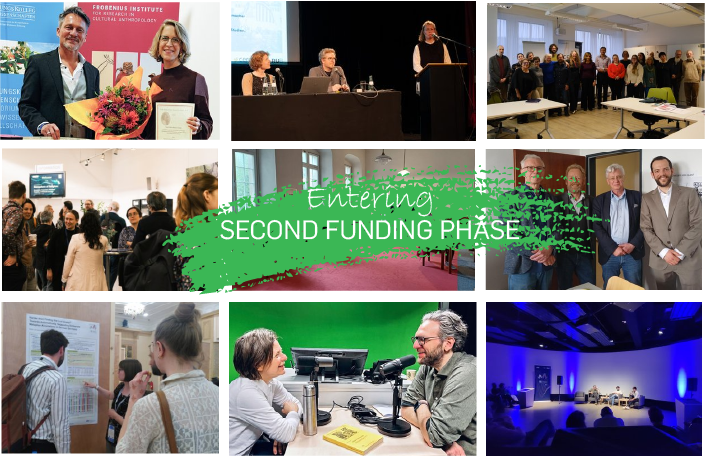
In its second funding phase, the CRC will further advance its theoretical, methodological, and comparative work. Particular attention will be devoted to the relationship between linguistic and conceptual metaphors, the development of an ontology of religious metaphors, and the refinement of digital methods for analyzing large text corpora. At the same time, the CRC is expanding its scope beyond textual sources. Future research will systematically include images, material objects, and performative practices such as rituals and theatrical performances in order to investigate metaphorical patterns across media and modes of communication.
By combining historical depth, cross-cultural comparison, digital infrastructure, and theoretical innovation, CRC 1475 makes a significant contribution to our understanding of religious meaning-making.